Scandium and Lutetium Metallacyclopropanes: Synthesis, Bonding, and Sterically Driven Reactivity
Dajiang Huang, Tianyu Li, Miaomiao Zhu, Junnian Wei, Yulong Li* and Wen-Xiong Zhang*
Inorg. Chem. 2026, 65,18916–18924.
https://doi.org/10.1021/acs.inorgchem.6c02602
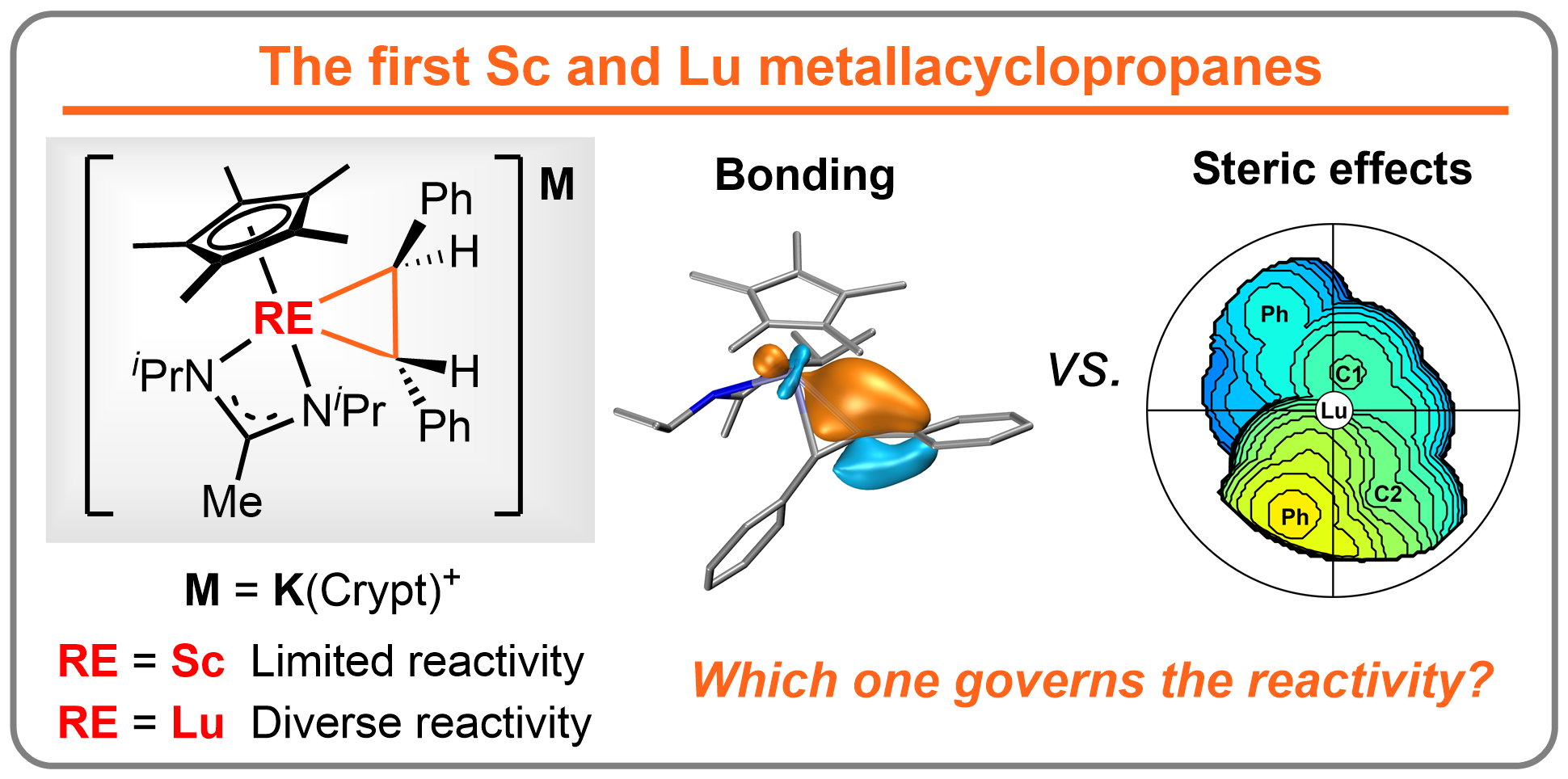
As the class of the smallest metallacycles, transition-metal metallacyclopropanes have been widely studied, whereas scandium, yttrium and lanthanide analogues have remained elusive. Herein, we report the first synthesis and characterization of scandium and lutetium metallacyclopropanes, 2-Sc and 2-Lu. Reactivity studies reveal a striking divergence: while 2-Sc is limited to redox processes, 2-Lu displays versatile insertion reactivity with various unsaturated substrates. DFT analysis indicates that the superior reactivity of 2-Lu is not driven by electronic nucleophilicity but by kinetic accessibility. The larger ionic radius and rare coordination mode of the Lu center provide a more open coordination sphere that outweighs electronic stabilization. This work highlights the important role of steric accessibility in controlling the divergent reactivity of highly strained Sc and Lu metallacyclopropane complexes.