Recently, several studies have shown that short tryptophan-containing peptides can undergo liquid–liquid phase separation (LLPS) to form multiphasic core-shell condensates. While such multiphasic condensates serve as excellent model systems for studying condensate organization, constructing synthetic organelles, and developing smart biomaterials, precisely tuning their architecture at the atomic level remains challenging. Furthermore, commonly used spectroscopic methods, such as fluorescence microscopy, cannot be used to characterize their structures due to a lack of useful intrinsically signals.
To address these challenges, Prof. Feng Gai's research group at the College of Chemistry and Molecular Engineering of Peking University incorporated the unnatural amino acid 4-cyanotryptophan (4CN-Trp, WCN) into short peptides that can undergo LLPS to form multiphasic condensates. Recently published online in the Journal of the American Chemical Society, their work demonstrates that substituting a single native tryptophan (W) with 4CN-Trp fundamentally inverts the core-shell architecture of the condensates formed upon LLPS. Additionally, the intrinsic blue fluorescence and nitrile infrared absorption band of 4CN-Trp enable the label-free characterization of the condensate microenvironment.
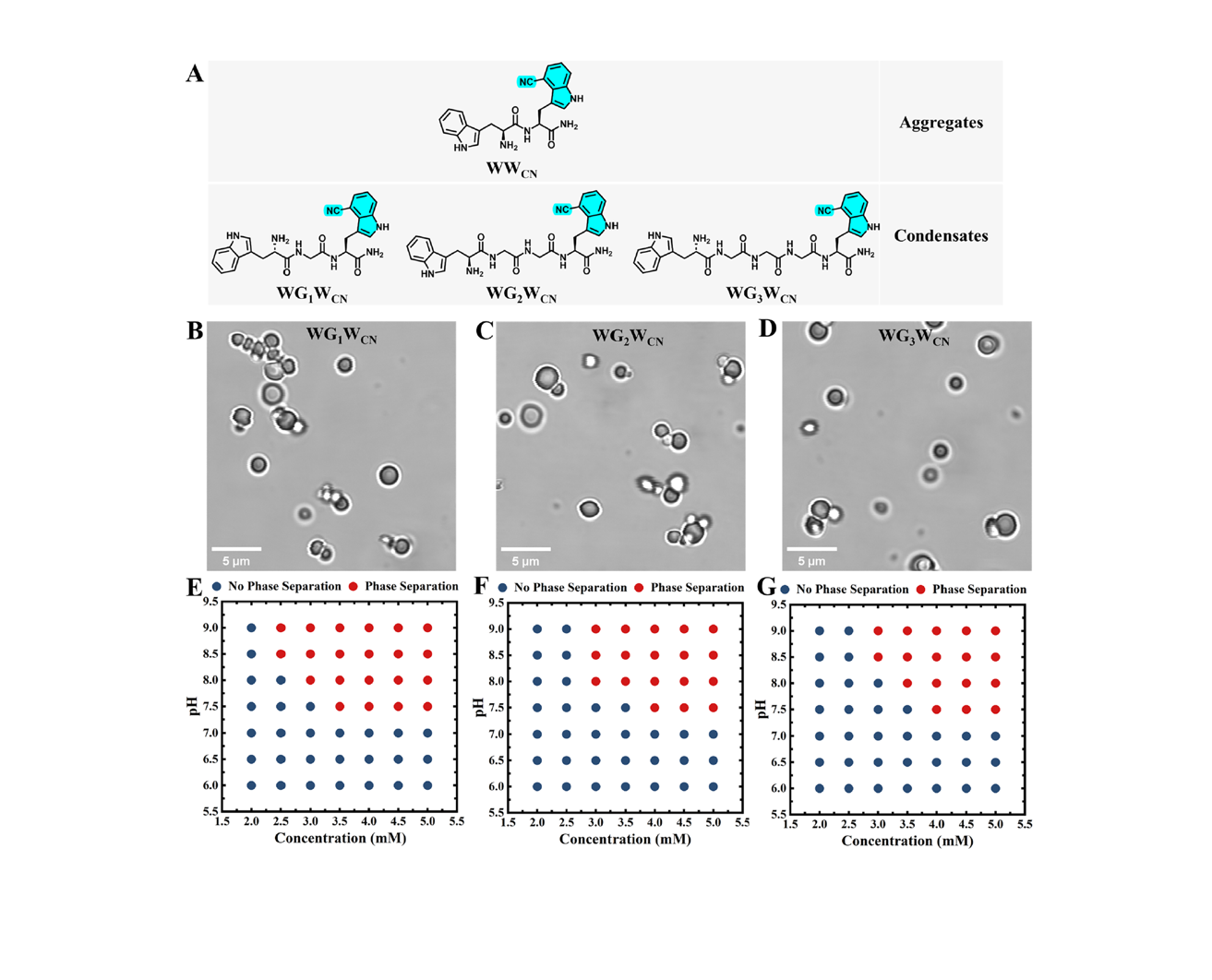
Using a "sticker-spacer" design principle, the authors synthesized a series of WGnWCN (n = 1-3) peptides, where natural tryptophan (W) and 4-cyanotryptophan (WCN) are positioned at opposite ends of the peptide chain, linked by glycine (G) spacer residues. Phase diagrams revealed that replacing native tryptophan with 4CN-Trp significantly lowered the critical concentration required for LLPS, altering the thermodynamic properties of the assembly without compromising its ability to undergo LLPS upon pH changes.
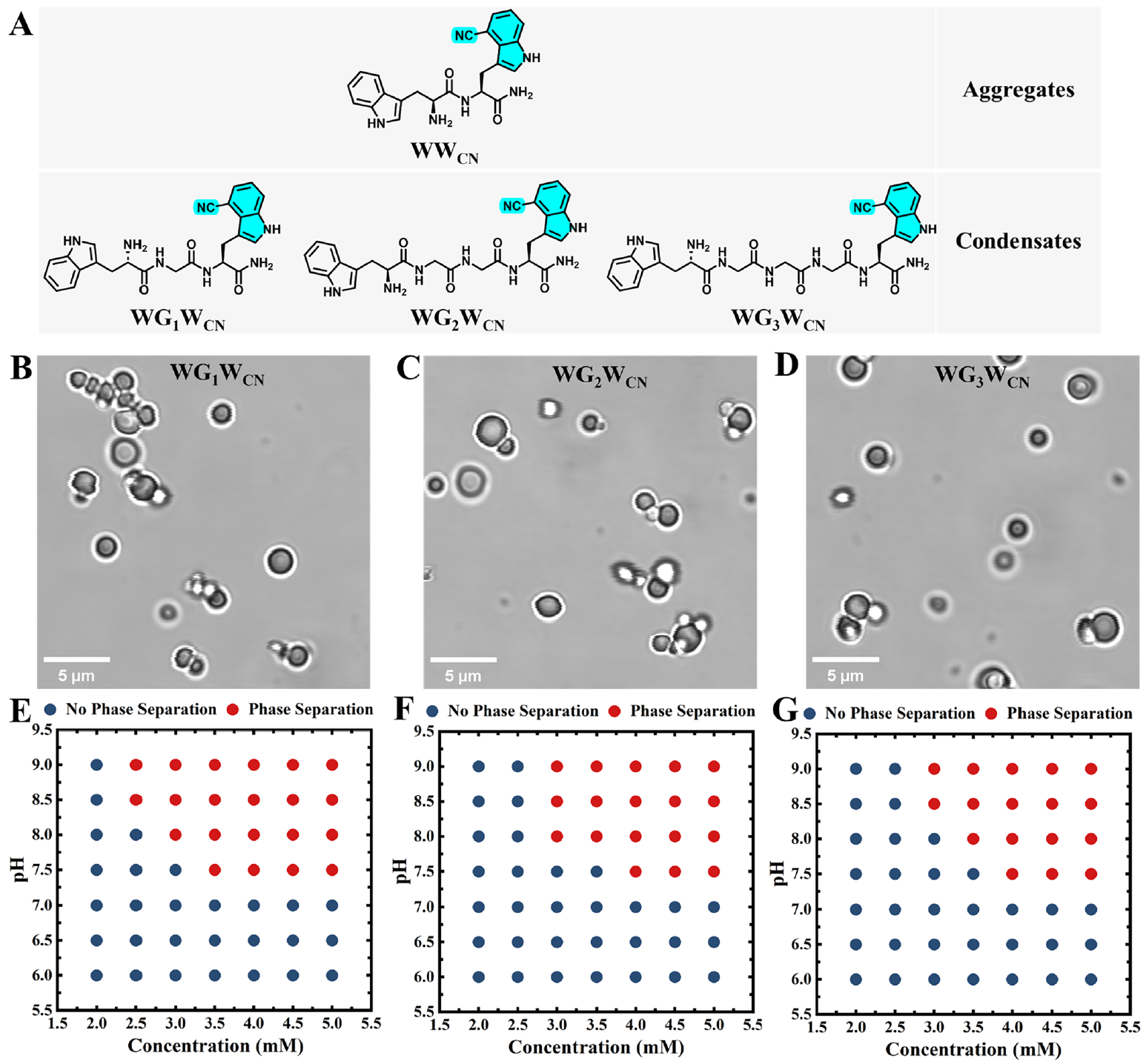
Figure 1. Molecular structures of the 4CN-Trp modified short peptides (A), bright-field images (B–D), and pH-concentration phase diagrams (E–G).
The authors systematically characterized the morphology, molecular fluidity, and microenvironmental properties of the condensates using a combination of two-photon excitation fluorescence imaging, fluorescence recovery after photobleaching (FRAP), fluorescence lifetime imaging microscopy (FLIM), cryogenic scanning electron microscopy (cryo-SEM), and infrared spectroscopy. Fluorescence intensity imaging revealed that the condensates consist of a bright perimetric outer shell and a relatively dimmer inner core (Figure 2A-C). FRAP results (Figure 2D-F) showed that after photobleaching the inner core region, the fluorescence intensity recovered by approximately 80% within a few minutes, indicating that the inner core possesses molecular diffusion and exchange capabilities. FLIM results (Figure 2G-I) indicated a longer fluorescence lifetime in the inner core and a shorter lifetime in the outer shell. Taken together, these imaging results reflect a denser and more rigid packing of the 4CN-Trp chromophores in the outer shell. This morphology is akin to that of biological vesicles, i.e., a fluid, aqueous lumen compartmentalized by a more highly structured boundary.
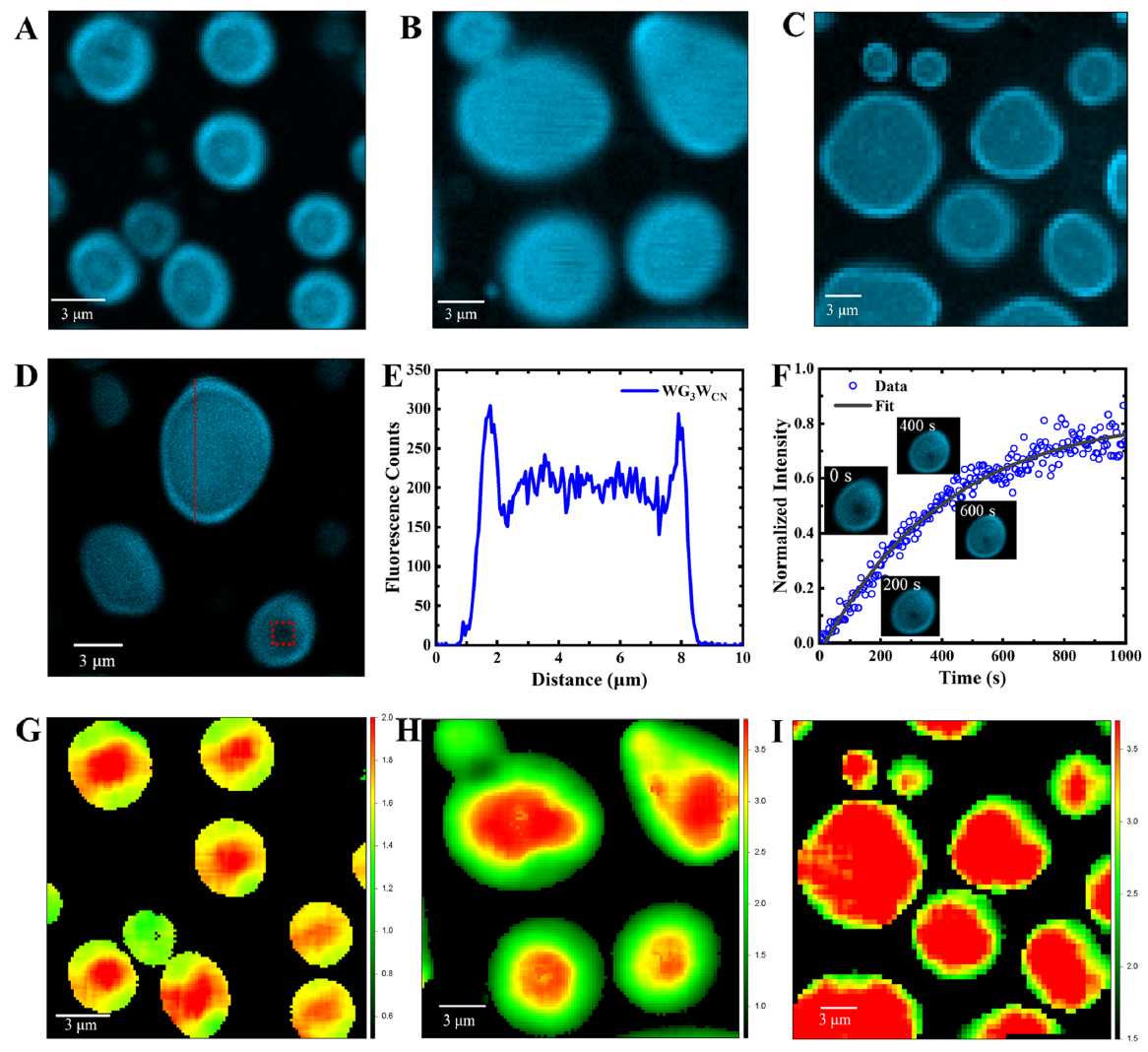
Figure 2. Fluorescence intensity imaging (A–C), FRAP analysis (D–F), and fluorescence lifetime imaging (G–I) of the multiphasic short-peptide condensates.
Cryo-SEM further revealed the cross-sectional morphology of the condensates (Figure 3). The outer layer of the WG1WCN condensates displayed a brighter, smoother contrast, indicating denser molecular packing and higher local electron density. The interior was relatively porous with lower electron density, suggesting a loosely packed or partially hydrated core phase. Cryo-SEM also captured intermediate states of condensate fusion, implying that despite the outer shell's solid-like characteristics, the condensate interface retains a certain degree of fluidity. Infrared spectroscopy characterizations further demonstrated that upon phase separation, the C≡N stretching vibration peak of 4CN-Trp exhibited a significant redshift. This confirms that the local electrostatic and hydration environment surrounding the cyano group was altered within the condensates.
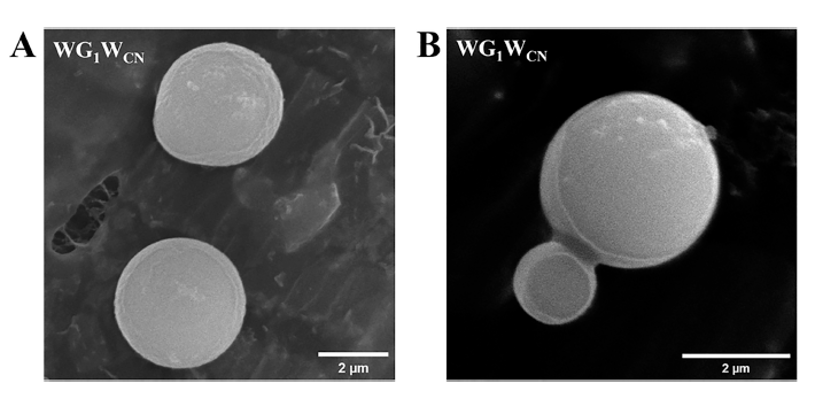
Figure 3. Cross-sectional morphology (A) and fusion process (B) of the WG1WCN condensates characterized by cryo-scanning electron microscopy (cryo-SEM).
In summary, this study demonstrates that a single atomic-level substitution to tryptophan functions as both a structural tuning unit and an intrinsic spectroscopic probe. By reprogramming peptide-water and peptide-peptide interactions, 4CN-Trp drives the core-shell architecture inversion. This dual-functional approach provides a novel, label-free strategy for the precise engineering and characterization of multiphasic condensates, synthetic organelles, and smart biomaterials.
PhD student Jin Li at Peking University is the first author of the paper, and Prof. Feng Gai is the corresponding author. Additional contributions were made by PhD student Ruozhu Xu, post-doctoral researcher Bo Zhuang, and undergraduate student Yuxiang Zhou. The research was supported by the Beijing National Laboratory for Molecular Sciences and the National Natural Science Foundation of China.
Original link for the paper: https://doi.org/10.1021/jacs.6c12051